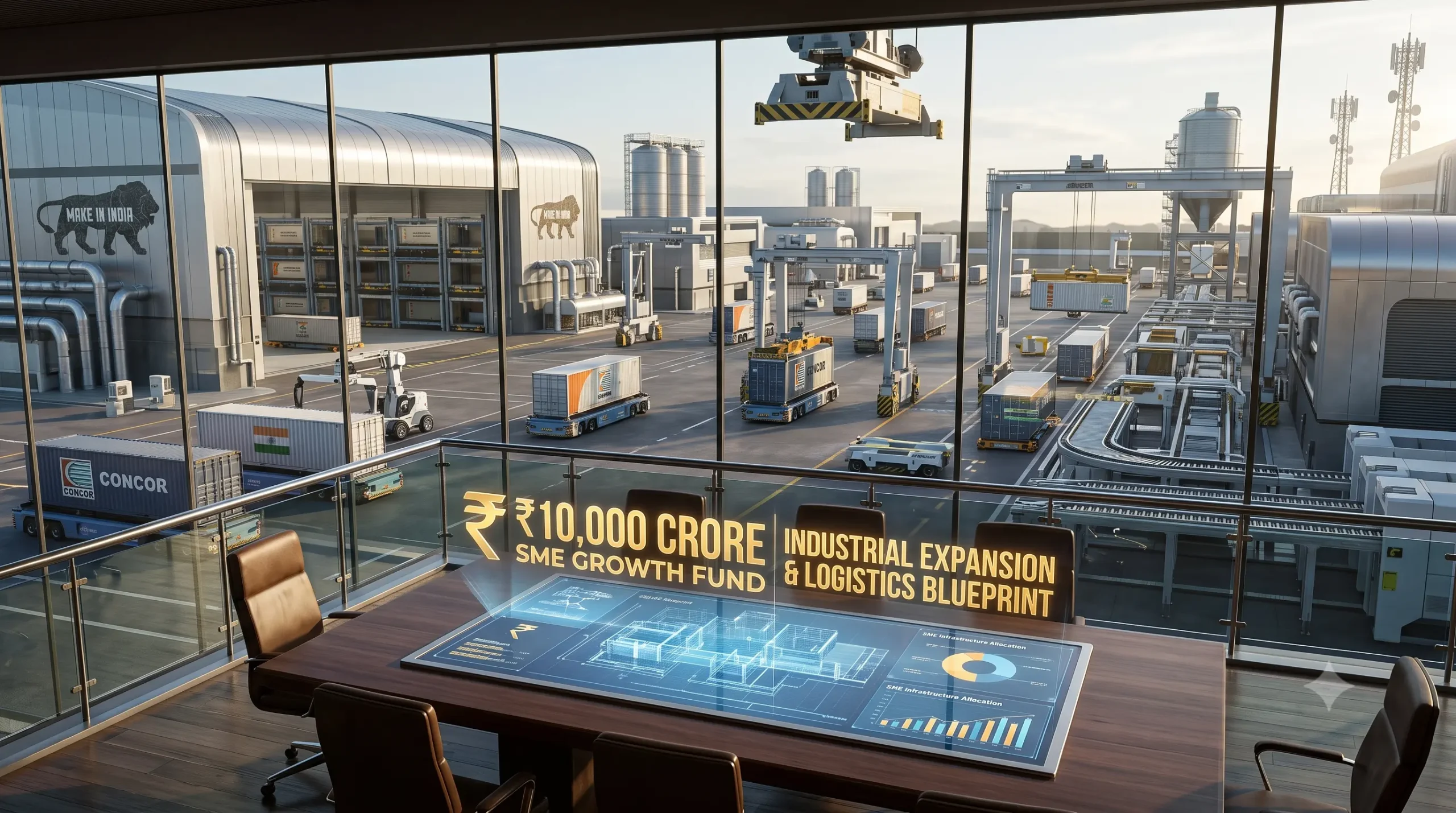
The Union Cabinet’s formal approval of the SME Growth Fund India 2026 marks a decisive turning point for domestic manufacturing and enterprise scale. Under this landmark economic blueprint, the central government has committed an upfront corpus of ₹10,000 crore to provide direct equity support to high-potential small and medium enterprises. In parallel, the Cabinet sanctioned the creation of the Integrated Transport & Logistics Authority to streamline intermodal freight movements nationwide. Consequently, entrepreneurs, industrial manufacturers, and financial markets are closely examining how these dual initiatives will transform business operations across the country.
Therefore, exploring the strategic architecture of the SME Growth Fund India 2026 will help business founders, suppliers, and investors capitalize on expanding public equity channels.
The Core Challenge: Why MSMEs Needed Equity Rather Than Debt
Historically, India’s MSME sector struggled primarily with capitalization ceilings. While traditional commercial banks readily provide debt instruments, small companies frequently hit balance-sheet limits:
- Excessive Debt Burden: High monthly borrowing interest drains vital operating cash reserves during early production phases.
- Strict Collateral Requirements: Commercial lenders routinely demand tangible real-estate collateral before extending working capital lines.
- Venture Capital Gaps: Mainstream venture funds disproportionately prioritize software applications over capital-intensive physical manufacturing units.
To bridge this structural gap, the government designed the fund to take direct equity and quasi-equity stakes. As a result, mid-sized enterprises can modernize machinery without inflating their monthly interest obligations.
Operational Blueprint: Fund Architecture and Allocation Model
The operational framework divides the fund’s capital into managed sub-funds overseen by certified institutional fund managers:
| Program Dimension | Standard Debt Route | New SME Growth Fund Model |
|---|---|---|
| Capital Nature | Bank loans carrying compounding interest | Direct equity partnership and patient capital |
| Approved Total Corpus | Ad-hoc individual bank approvals | ₹10,000 Crore dedicated national allocation |
| Target Beneficiaries | Standard collateral-backed firms | High-growth manufacturing, engineering, and green tech |
| Exit Mechanism | Foreclosure upon loan default | Structured SME IPOs or private buybacks |
As a result, viable industrial units can expand production facilities ahead of global export commitments.
Eligibility Criteria: Who Can Access Equity Backing?
Accessing the growth fund requires adherence to transparent corporate governance norms:
- The applicant entity must be a registered enterprise with an active Udyam portal registration.
- The business must exhibit consistent positive operating performance over the past two financial cycles.
- Clear plans for capacity expansion, domestic import substitution, or export generation must be demonstrated.
- Clean tax compliance track records remain mandatory across both direct and indirect assessment heads.
Meanwhile, business proprietors evaluating relief against tax audits can review our recent analysis on GST Council arrest powers scrapped.
Integrated Transport & Logistics Authority: Cutting Supply-Chain Friction
Financing manufacturing solves only half the structural equation; transporting goods rapidly to ports represents the remaining challenge. Currently, logistics costs consume roughly 13% to 14% of India’s Gross Domestic Product. In contrast, developed western economies maintain logistics expenditures below 8%.
To eliminate inter-state bottlenecks, the new unified authority consolidates roadway freight, rail corridors, and coastal shipping routes under a single digital window. Consequently, manufacturers can transport heavy machinery and raw minerals across industrial corridors without facing fragmented regulatory checks at state borders.
Complementing Working Capital and Credit Access
While the equity fund provides growth horsepower, day-to-day liquidity management still requires careful planning. Smaller vendors unable to qualify for institutional equity can continue leveraging retail credit facilities.
Entrepreneurs managing short-term cash flow gaps can explore collateral credit benchmarks in our explainer on the RBI new gold loan rules 2026.
For verified cabinet resolutions, notifications, and gazette transcripts, visit the official Press Information Bureau (PIB) portal.
Long-Term Impact on Employment and Stock Listings
By injecting patient equity capital into mid-sized industrial ventures, the initiative prepares domestic companies for public equity markets. A large percentage of these enterprises are expected to list on the NSE Emerge and BSE SME platforms over the coming three to five years. Furthermore, capital expansion across manufacturing units drives localized formal employment opportunities in tier-2 and tier-3 industrial belts.
Final Takeaway
In summary, the rollout of the SME Growth Fund India 2026 alongside the national logistics overhaul provides a complete ecosystem upgrade for Indian industry. Rather than relying solely on debt, entrepreneurs now possess a clear roadmap to secure growth capital and transport inventory without bureaucratic delay. Ultimately, leveraging these coordinated government initiatives will empower Indian manufacturers to build globally competitive enterprises.